
Introduction: A hybrid battery is a high-voltage energy storage pack that helps power the electric motor in a hybrid vehicle. It works with the petrol engine, control system, and regenerative braking system to reduce fuel use while keeping the vehicle practical for daily driving. For owners, workshops, parts distributors, importers, and fleet teams, knowing how this system works makes battery testing, maintenance, sourcing, and replacement much easier.
Key Takeaways
- A hybrid uses a high-voltage traction pack and a separate 12V unit.
- The traction pack supplies energy to the electric motor.
- Regenerative braking returns energy to the pack.
- The petrol engine may also help generate electrical energy.
- A conventional hybrid does not usually need external charging.
- Voltage testing is one part of assessing pack condition.
- Business buyers should confirm model, generation, quantity, and voltage needs.
What does the high-voltage pack do?
The high-voltage pack stores electrical energy and supplies it to the vehicle’s electric motor. It supports low-speed movement, acceleration, and other driving conditions chosen by the vehicle’s control system.
A hybrid vehicle has two sources of driving power: an internal combustion engine and one or more electric motors. The vehicle manages these sources as driving conditions change. It may use electric power for some low-speed movement, combine electric and engine power during acceleration, or rely more heavily on the engine at other times.
The hybrid electric vehicle battery makes this cooperation possible. Without stored electrical energy, the motor could not provide useful drive assistance. The pack also receives energy that would otherwise be lost during braking.
According to the U.S. Department of Energy Alternative Fuels Data Center, hybrid electric vehicles use an internal combustion engine and one or more electric motors. Their batteries receive energy through regenerative braking and from the engine rather than through an external charging connection.
Is it the same as a normal 12V unit?
No. The high-voltage traction pack and the conventional 12V unit perform different jobs, even though both are important to vehicle operation.
The traction pack supplies the electric drive system. The smaller 12V unit supports low-voltage electrical functions and helps the vehicle’s systems start their normal operating sequence. A weak 12V unit can therefore cause warning signs or starting trouble without proving that the high-voltage pack has failed.
This distinction matters during fault finding. Replacing a traction pack will not correct a fault caused by the 12V system, a connection, or another vehicle component. Workshops should read fault information and inspect the relevant system before recommending a major replacement.
- Dash lights flicker, reset, or appear weak
- Vehicle struggles to wake up or start its normal sequence
- Locks, screens, or accessories behave irregularly
- Symptoms feel broad and electrical rather than drive-related
- Hybrid drive behaviour changes during acceleration or low-speed assist
- Charge use or energy recovery seems abnormal
- Vehicle performance shifts when motor support should be active
- Fault information points toward the hybrid battery system
What are the main differences between the two power units?
The traction pack handles electric drive energy, while the 12V unit supports lower-voltage systems. Their size, role, handling needs, and testing methods differ.
How does stored energy move through the vehicle?
Energy moves between the pack, power control system, and electric motor. The vehicle decides when to use, save, or recover that energy based on speed, driver demand, and operating conditions.
When electric assistance is useful, the traction pack sends electrical energy through the vehicle’s power electronics. The electric motor then converts that energy into movement. During harder acceleration, the motor can work with the petrol engine rather than acting alone.
When the vehicle slows, the process can work in reverse. The drive motor can help convert vehicle movement into electrical energy. The system sends that recovered energy back to the pack for later use.
The exact operating pattern differs by vehicle design. Drivers may notice the petrol engine starting and stopping during a journey. That change does not mean the system is behaving at random. The vehicle’s controls manage the available power sources based on current demand.
How does a hybrid car charge while driving?
The answer to how does a hybrid car battery charge is mainly regenerative braking and engine-supported generation. A conventional hybrid manages this process automatically while the vehicle is driven.
Regenerative braking captures part of the vehicle’s movement as it slows. Instead of relying only on friction brakes, the hybrid system uses the electric motor as a generator during suitable braking conditions. The recovered energy returns to the high-voltage pack.
The petrol engine can also contribute to electricity generation. The vehicle controls when this happens, so the driver does not have to select a charging mode during ordinary use.
A plug-in hybrid differs because it also has an external charging connection. That distinction is important when discussing charging habits, battery capacity, vehicle range, or workshop procedures. A conventional hybrid and a plug-in hybrid should not be treated as identical systems.
Does the vehicle run only on electric power?
Sometimes it may use electric power for short periods, but a conventional hybrid still depends on its engine. The motor and engine work separately or together as conditions require.
At low speed or under light demand, the electric motor may move the vehicle without immediate engine assistance. During faster acceleration, climbing, or heavier demand, the petrol engine can provide more power while the motor adds support.
The hybrid engine battery is therefore not an engine starter in the ordinary sense. It forms part of a managed drive system. Its purpose is to store and deliver energy when the hybrid controls call for electric propulsion or assistance.
What is inside the traction pack?
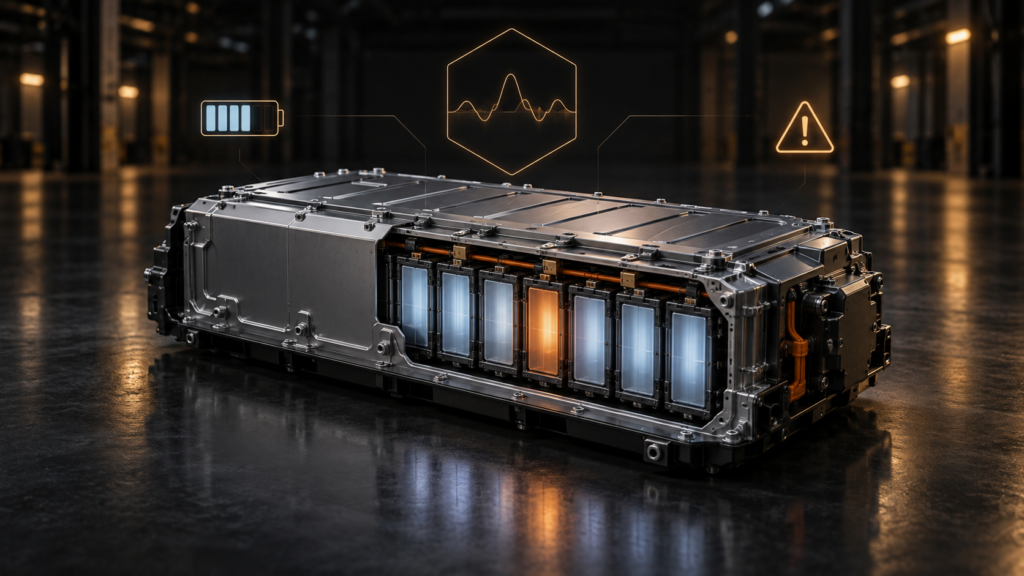
A traction pack contains connected battery sections, electrical connections, monitoring components, and a protective case. Together, they allow the vehicle to store energy and track pack operation.
People often use the word battery as if the pack were one large cell. In practice, the high-voltage unit contains multiple connected sections. The vehicle monitors the pack so it can manage energy flow and identify operating faults.
This structure explains why a simple voltage reading does not answer every condition question. A complete pack can show voltage while still needing further checks. Workshops may need to consider fault codes, section balance, connections, operating behaviour, and vehicle-specific information.
High-voltage systems also require careful handling. The National Highway Traffic Safety Administration notes that electric and hybrid vehicles use high-voltage battery systems and discusses the safety considerations linked to these vehicles. Owners should not open or disturb a traction pack without suitable training and equipment.
Why does voltage matter?
Voltage helps confirm whether a pack matches a vehicle requirement and supports condition assessment. However, voltage should form part of a wider inspection rather than act as the only test.
For business buyers, the requested voltage also helps a supplier identify suitable stock. Model names alone may not provide enough detail because vehicle generations and system requirements can differ.
Testing is especially important in used supply. Hybrid Hive sources through trusted partners in Japan, including dismantlers and dealership-related or certified supply channels. Units entering its UAE supply network undergo dual inspection, voltage testing, and condition checks before they become part of business-ready inventory.
Buyers who want a broader look at commercial checks can read this guide to sourcing, testing, and stock readiness. It explains why supply quality depends on more than finding a matching product name.
Why can condition vary between used packs?
Used pack condition can vary because each unit has a different source vehicle and operating history. Sourcing controls, inspection, testing, storage, and correct identification help reduce uncertainty.
Low-mileage sourcing can support a stronger supply pool, but buyers still need clear checks. A professional supplier should confirm the product type, inspect its condition, test relevant voltage values, and store stock in an organised way.
For distributors and workshops, consistency matters as much as one successful order. Repeat purchasing becomes difficult when descriptions change, stock cannot be confirmed, or models arrive without enough identification. A dependable supply process gives the buyer clearer information before payment and dispatch.
This is also where tested reuse has practical value. A good-condition used hybrid vehicle battery can return to commercial service rather than leaving a usable component idle. That approach supports second-life use while helping workshops, resellers, and fleet teams manage replacement spending.
What should business buyers confirm before ordering?
Business buyers should confirm the vehicle model, generation, quantity, voltage requirement, pack condition, collection method, and shipping need. Clear order details reduce delays and compatibility mistakes.
A request that says only “Toyota battery” is too broad. Toyota Prius, Toyota Aqua or Yaris, Toyota Camry, and other models do not all use the same unit. Lexus RX Hybrid requirements also need clear identification.
Commercial buyers should provide all known details at the first contact. The supplier can then check available stock, prepare a transparent quotation, and suggest an alternative when the exact requested unit is not available.
Which details make a commercial request easier to process?
A complete request identifies the vehicle and the commercial need. It should also state whether the buyer expects warehouse pickup or international shipment.
| Information to provide | Why it matters | Example of a clear request |
|---|---|---|
| Vehicle model | Narrows the stock search | Toyota Prius |
| Generation or known vehicle details | Helps separate different system versions | Provide the known generation or vehicle reference |
| Quantity | Allows a bulk stock check | 20 units |
| Voltage requirement | Supports compatibility review | State the required pack voltage |
| Order pattern | Helps plan one-time or repeat supply | Monthly workshop requirement |
| Delivery method | Guides collection or shipment preparation | Sharjah warehouse pickup or international shipment |
Hybrid Hive follows a clear business process. The buyer submits the model, generation, quantity, and voltage requirement. Stock is then checked, availability is confirmed, and a quotation is prepared. After payment confirmation, the order can be arranged for UAE warehouse collection or shipment.
For a closer view of procurement steps, the article on how wholesale supply works explains the route from a buyer request to stock confirmation and fulfilment.
Why does steady stock matter to workshops and distributors?
Steady stock helps businesses schedule repairs, fulfil customer orders, and plan repeat purchasing. It also reduces the risk of accepting work before a suitable unit can be found.
A workshop may need one model often, while a distributor may carry stock for several markets. Importers also need enough units to make shipping and order handling practical. Fleet maintenance teams have another concern: keeping vehicles available without holding unsuitable inventory.
Hybrid Hive maintains UAE stock for high-demand models, including Toyota Prius, Toyota Aqua or Yaris, Toyota Camry, and Lexus RX Hybrid, with availability for other hybrid models. Its stated supply record includes more than 20,000 batteries supplied or processed and support for more than 300 bulk orders. A 4.9 positive review signal also adds a visible measure of customer confidence.
For mixed purchasing needs, the company’s automotive batteries supply focuses on commercial availability rather than casual retail sales. The intended buyers include parts distributors, automotive workshops, importers, resellers, and fleet maintenance teams.
How can owners recognise a possible system problem?
Warning lights, changed vehicle behaviour, or recorded fault information may point to a problem, but they do not identify the cause by themselves. A qualified diagnostic check should come before a replacement decision.
A warning may relate to the traction pack, the 12V system, cooling, electrical connections, sensors, or another part of the vehicle. Guessing from one symptom can waste time and money.
First-time hybrid owners should record when the warning appeared and whether driving behaviour changed. They can then share that information with a workshop. Diagnostic fault data and vehicle-specific testing provide a better basis for repair than age alone.
The same rule applies to a replacement unit. Correct model identification and condition checks matter more than a vague claim that a pack “fits Toyota” or “works with hybrids.” Buyers should ask for clear stock information and should not treat all packs as interchangeable.
Can owners test the high-voltage pack themselves?
Owners should leave high-voltage pack testing and internal work to trained personnel with suitable tools. Visual curiosity is not a safe reason to open the protective case.
A workshop can begin with vehicle diagnostics and system checks. If replacement stock is needed, business buyers may also ask whether a supplier allows testing at the warehouse. Hybrid Hive supports warehouse-based checks within its organised supply process, giving commercial buyers a clearer view before collection.
How does wholesale supply differ from retail replacement?
Wholesale supply focuses on quantity, repeat access, clear stock identification, and fulfilment. Retail replacement usually centres on one vehicle and may include services that do not apply to a commercial parts order.
A distributor may need mixed model stock. A workshop group may want regular units for common repairs. An importer may need export preparation, while a fleet team may focus on predictable access for planned maintenance.
These buyers need more than a product listing. They need fast availability confirmation, a clear quotation, tested condition, and a reliable collection or shipping route. Stock continuity can affect repair schedules and customer commitments.
Hybrid Hive operates from Sharjah, UAE, and prepares bulk-ready stock for warehouse pickup or international shipment. Its Japan-linked sourcing, dual inspection, voltage checks, and large inventory support repeat commercial orders. This positions the business as a supply partner for companies that depend on working stock rather than an occasional consumer seller.
Summary
A high-voltage traction pack stores electrical energy for a hybrid vehicle’s motor. It receives energy through regenerative braking and engine-supported generation in a conventional hybrid, while a separate 12V unit handles lower-voltage functions.
Understanding that difference helps owners discuss faults more clearly and helps workshops avoid rushed replacement decisions. For distributors, importers, resellers, and fleet teams, the commercial priorities include compatibility, tested condition, stock volume, repeat availability, and fulfilment.
Hybrid Hive supplies good-condition used units from its Sharjah inventory, with sourcing links in Japan, dual inspection, voltage testing, warehouse pickup, and international shipping support. Businesses seeking a bulk-ready hybrid car battery supply can submit the model, generation, quantity, and voltage requirement for an availability check and quotation.
Frequently Asked Questions
Find answers to common questions about our hybrid battery supply, ordering process, and delivery options.
No. A conventional hybrid receives electrical energy through regenerative braking and engine-supported generation. A plug-in hybrid also allows external charging and should not be confused with a conventional hybrid.
No. The two units have different roles. The high-voltage pack supports the electric drive motor, while the 12V unit supports lower-voltage vehicle systems and the normal start-up sequence.
No. A warning light shows that the vehicle has detected an issue, but diagnosis is needed to identify the cause. Fault data, electrical checks, and vehicle-specific testing should guide the next step.
The buyer should provide the model, generation or known vehicle details, quantity, voltage requirement, order pattern, and preferred fulfilment method. This information supports a faster and more accurate stock check.
Hybrid Hive maintains business-ready inventory for high-demand models such as Toyota Prius, Toyota Aqua or Yaris, Toyota Camry, and Lexus RX Hybrid, while also supporting other models subject to stock availability. Orders can be prepared for warehouse collection in Sharjah or international shipment.