
Introduction: Wholesale supply works very differently from casual retail buying. For distributors, workshops, importers, resellers, and fleet maintenance teams, the real issue is not just finding stock once. It is finding a dependable Sharjah, UAE supply partner that can confirm availability fast, quote clearly, test units before release, and support repeat orders without confusion. That is the model Hybrid Hive presents: a business-focused supplier sourcing from trusted partners in Japan, checking condition and voltage, holding business-ready inventory in the UAE, and arranging either warehouse pickup or shipment after payment confirmation.
Key Takeaways
- Wholesale supply is built for repeat business, not one-off consumer buying.
- Good buyers send model, generation, quantity, and voltage details first.
- Fast stock confirmation depends on clear request data and live inventory checks.
- Testing and condition checks matter more than attractive listing language.
- Pickup and shipment need different planning, paperwork, and handling.
- Repeat orders get easier when buyers standardize models and quantities.
- Hybrid Hive positions itself around transparent quotes, stock reliability, and export support.
What does wholesale supply actually mean for battery buyers?
It means the process is built for commercial continuity, not impulse purchasing. The focus is steady stock, fit for common models, testing, quotation clarity, and repeat-order support.
In practice, wholesale supply starts with business needs. A workshop may need replacement packs for current repair jobs. A distributor may need mixed inventory for regional resale. A fleet team may need a regular source that can handle the same vehicle families again and again.
For that reason, a structured hybrid battery source is valuable because it supports the full chain, not only the item on the shelf. Buyers need sourcing transparency, stock depth, fast answers, and a clear path from inquiry to collection or shipment.
Hybrid Hive frames that model around commercial demand. The company focuses on wholesale-ready stock for popular models such as Toyota Prius, Toyota Aqua or Yaris, Toyota Camry, and Lexus RX Hybrid, while also indicating support for other hybrid models. Its messaging also stresses trusted Japan sourcing, dual inspection, voltage testing, warehouse stock in the UAE, and readiness for bulk and repeat orders.
That matters because business buyers measure risk differently. A single failed order can slow a workshop, leave a reseller short of promised stock, or disrupt fleet maintenance planning. A supplier with more than 140,000 batteries supplied or processed, more than 300 bulk orders supported, and a 4.9 positive review signal gives buyers more reason to treat the process seriously.
Who usually uses this type of supply model?
Mainly commercial buyers that need reliable flow, not casual shoppers. The most common users are parts distributors, auto workshops, importers, resellers, and fleet maintenance teams.
These buyers care about consistency. They also care about communication. If stock is not available in one exact version, they need a fast answer and a workable alternative. That is why organized battery supplies matter so much in this market.
A consumer may search for a bargain once. A workshop, by contrast, needs usable stock today and a known process for next week. That is the core difference.
How does the process move from request to quotation?
It usually starts with a detailed inquiry and then moves through stock confirmation, quotation, payment, and release. The cleaner the first request, the faster the rest of the process tends to be.
Hybrid Hive describes a clear operating flow. The buyer sends vehicle model, generation, quantity, and voltage requirement. The company checks current stock, confirms availability quickly, prepares a quotation, suggests alternatives if needed, and then arranges pickup or shipment after payment confirmation.
What information should a buyer include in the first request?
Buyers should send exact model details, generation, required quantity, and voltage needs. They should also mention whether they want warehouse pickup or shipment.
Many people first search for phrases like buy hybrid battery, but wholesale purchasing only gets efficient when the request is precise. A short message that says “need Prius stock” is rarely enough. A better request gives the supplier something concrete to check against live inventory.
Table: Buyer request checklist for faster stock confirmation
| Request detail | Why it matters | Example |
|---|---|---|
| Vehicle model | Lets the supplier match the correct stock family | Toyota Prius |
| Generation or year range | Helps avoid wrong fit or wrong pack version | Prius 3rd generation |
| Quantity needed | Shows whether the order is single, mixed, or bulk | 10 units |
| Voltage requirement | Supports correct stock screening and testing discussion | Required tested voltage range on request |
| Collection or shipment | Changes packing, timing, and documentation | Warehouse pickup in Sharjah |
| Urgency and repeat demand | Helps the supplier plan alternates and future supply | Monthly restocking for workshop use |
When buyers send this information early, stock checks move faster. Quotes also become clearer because the supplier does not need to guess what the buyer actually needs.
How is stock checked and confirmed?
Stock confirmation means the supplier checks current inventory against the request and replies with availability. If exact stock is not available, a good supplier suggests realistic alternatives.
This step sounds simple, but it is where many weak trading operations fail. Some listings show parts that are not actually ready. Others take too long to answer. In wholesale work, that delay costs time and trust.
Hybrid Hive presents fast availability confirmation as part of its process. That is useful for business buyers because it helps them decide whether to wait, switch to an alternate model line, or split an order.
A page may advertise a hybrid battery for sale, but a serious buyer still needs live stock proof, not just a product phrase. The same is true for broad listings that show hybrid batteries for sale without clear quantity or testing information behind them.
What happens after the quote is approved?
Once the buyer accepts the quote and payment is confirmed, the order moves to release. That release can be warehouse collection or shipment, depending on what was agreed.
This is where organized supply becomes visible. Clear quotations reduce back-and-forth. Confirmed payment gives both sides a defined handover point. From there, the supplier can prepare the units for pickup in Sharjah or arrange dispatch for export or regional delivery support.
Hybrid Hive’s process matters here because it shows operational structure rather than vague trading language. For commercial buyers, that structure often matters as much as the stock itself.
Why do testing and condition checks matter so much?
They help reduce avoidable issues before stock leaves the warehouse. For a business buyer, testing is part of risk control.
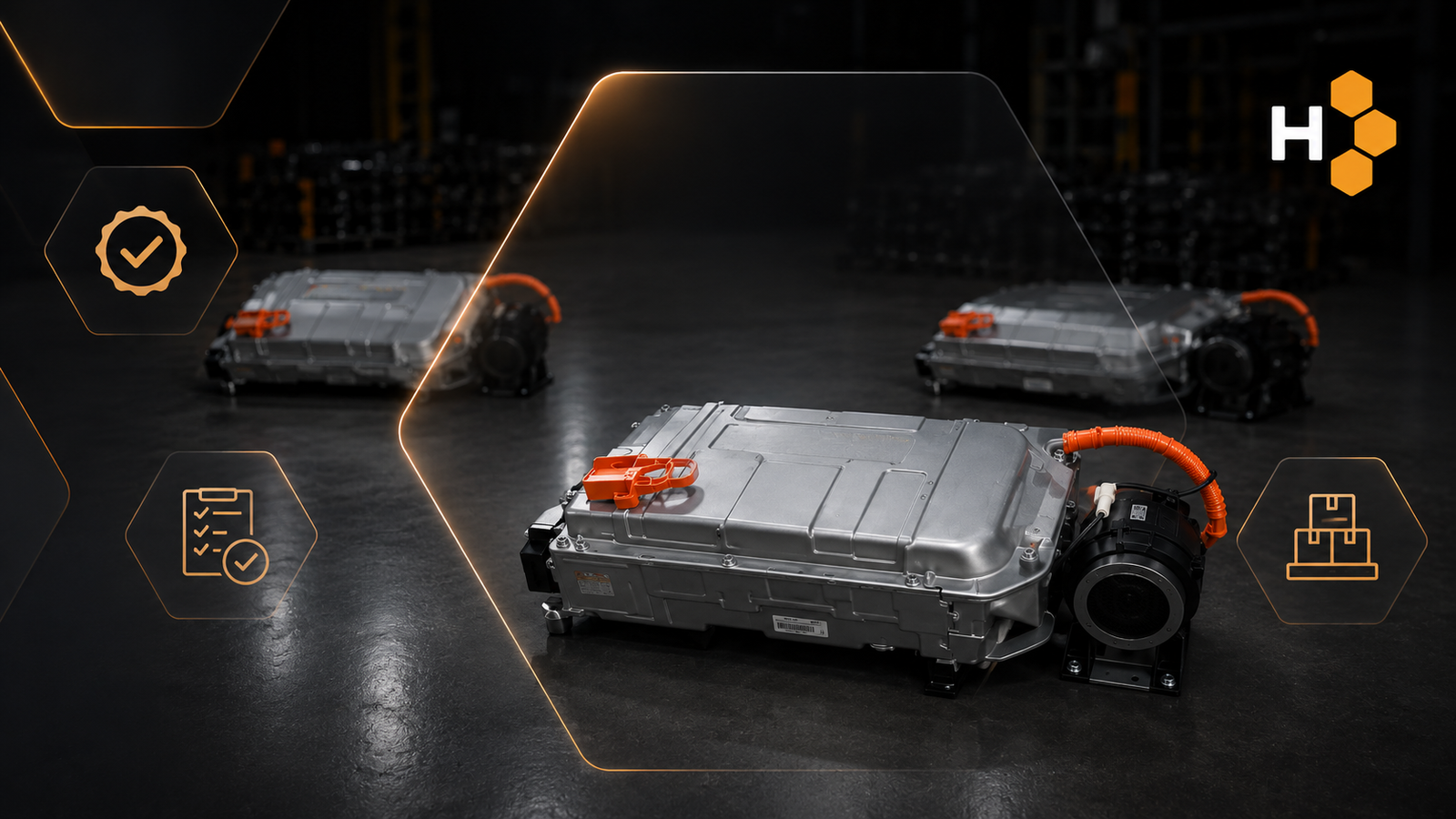
Hybrid Hive states that stock is dual-inspected, voltage-tested, and checked for good condition before release into its UAE supply network. That is important for workshops and distributors because visual appearance alone does not tell the full story.
The difference is simple. Untested stock creates uncertainty. Tested stock gives the buyer a clearer base for installation planning, resale decisions, and inventory control.
Which checks help lower avoidable problems?
Basic checks should confirm condition, voltage, model fit, and unit readiness for release. Wholesale buyers also benefit from clear communication about any alternate options.
Commercial buyers often compare listings quickly. However, visible stock and low pricing are not enough. A stronger process checks that the pack matches the requested vehicle family, confirms the stated quantity, and screens units before they move out.
That is why many workshops prefer a source of tested hybrid batteries rather than random auction-style purchasing. It is easier to plan jobs when the supplier follows a repeatable inspection routine.
- Check model and generation details against the request.
- Confirm the quantity actually available now.
- Review voltage testing results where relevant to the order.
- Inspect overall condition before packing or release.
- Ask about alternatives if the exact requested stock is short.
Why does Japanese sourcing support steadier stock?
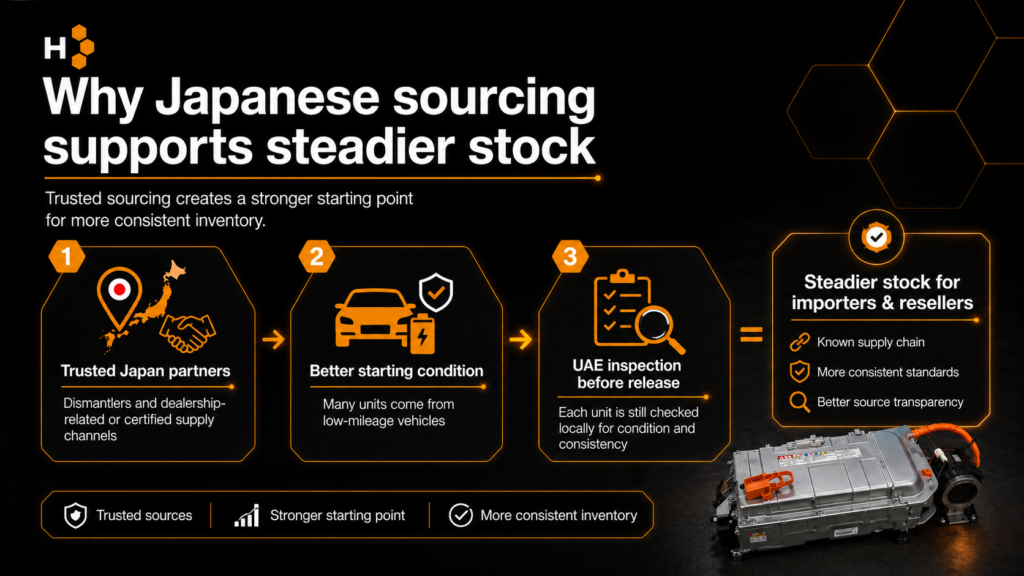
Because source quality affects what arrives in the warehouse. Trusted sourcing channels help the supplier maintain more consistent inventory standards.
Hybrid Hive says its stock is sourced through trusted partners in Japan, including dismantlers and dealership-related or certified supply channels, often from low-mileage vehicles. That does not remove the need for inspection in the UAE. It does, however, create a stronger starting point for condition and consistency.
For importers and resellers, source transparency matters. They want to know whether stock comes through a known chain or from uncertain mixed lots. A supplier that can explain where units come from and how they are checked stands out for the right reasons.
What should buyers know about pickup, packing, and shipment?
They should know that release planning changes based on delivery method. Warehouse pickup is simpler, while shipment usually needs more coordination and paperwork.
Hybrid Hive states that orders can be prepared for warehouse pickup or for international shipment support after payment confirmation. That is useful for buyers inside the UAE and for those buying from abroad, but each route has its own planning needs.
What changes between warehouse pickup and shipment?
Pickup focuses on collection timing and loading. Shipment adds packing method, route planning, and document handling.
Table: What buyers usually prepare for pickup versus shipment
| Order route | What the buyer should confirm | Why it matters |
|---|---|---|
| Warehouse pickup | Collection date, vehicle access, loading responsibility | Keeps handover smooth and avoids delays at the warehouse |
| Local or regional dispatch | Delivery address, contact person, receiving hours | Helps the shipment reach the correct business site |
| International shipment | Destination country, consignee details, import needs | Supports export planning and buyer-side clearance steps |
| Mixed bulk orders | Packing split, model labeling, quantity by line item | Makes unloading and onward distribution easier |
For repeat buyers, this is worth documenting once and reusing. The more standardized the pickup or shipping instruction, the easier future orders become.
What rules matter when batteries cross borders?
Transport rules can change with chemistry, route, and shipping mode. Buyers should never assume that all battery shipments are treated the same way.
For example, according to PHMSA, lithium battery transport is subject to specific safety requirements and packaging rules. That matters to commercial buyers because export support is not just about finding stock. It is also about preparing the shipment in a way that matches the route and the product type.
This does not mean every order will face the same paperwork. It does mean serious buyers should ask early about destination requirements, handling needs, and any carrier limits that could affect timing.
How does reuse support cost control and sustainability?
Reuse helps extend the working life of automotive components when stock is checked and handled properly. It also supports a practical circular economy approach for commercial vehicle maintenance.
That balance matters to many buyers. They want performance and cost control, but they also want supply choices that reduce waste. The wider industry context supports careful handling as well. The US EPA notes that used lithium-ion batteries should be sent through appropriate recycling and management channels rather than put in household trash.
For a B2B buyer, the key point is simple: organized reuse is not a vague sustainability claim. It is part of how workshops, fleets, and resellers keep useful components in circulation while managing stock responsibly.
How can buyers make repeat orders easier?
They can standardize their request data, track fast-moving models, and keep a clear buying pattern with the supplier. Repeat orders get easier when both sides already know the needed format.
A workshop that regularly handles the same vehicle families should keep a ready list of model lines, generations, expected monthly quantities, and pickup or shipping preference. That saves time on every order. It also helps the supplier suggest practical alternatives when one line runs tight.
Hybrid Hive’s commercial positioning fits that approach well. The company speaks to distributors, workshops, importers, resellers, and fleet teams that need a business process, not just a one-time product listing. Even its basic content footprint, including a simple website under construction post, suggests a site being built around ongoing information and support rather than a single catalog page.
Which models tend to move fastest?
Demand usually concentrates around common hybrid vehicle lines with active workshop and resale demand. Popular Toyota and Lexus applications often sit near the top of that list.
Hybrid Hive highlights Toyota Prius, Toyota Aqua or Yaris, Toyota Camry, and Lexus RX Hybrid as core high-demand stock lines, while also indicating availability for other models. For buyers, that matters because common vehicle families often make the best repeat-order candidates.
If a business frequently needs the same applications, it should not wait until a job is urgent. It should forecast likely monthly demand and keep a short list ready for quotation requests. That is far more useful than searching again every time a customer asks for a pack.
What makes a structured supplier better than a one-off trader?
A structured supplier offers process, stock visibility, testing, and repeat-order support. A one-off trader may only offer a product photo and a price.
The difference shows up at every step. A structured supplier can explain source channels, confirm live inventory, provide clear quotations, prepare pickup or shipment, and support future orders with less friction. That is exactly why businesses compare serious stock partners instead of relying on random listings.
When buyers assess car battery suppliers, they should look past headline pricing and ask a few simple questions:
- Can the supplier confirm stock quickly?
- Is the stock checked for condition and voltage?
- Can the supplier support bulk and repeat orders?
- Are pickup and shipment handled in an organized way?
- Is the sourcing story clear enough to trust?
Hybrid Hive’s published positioning answers those questions in a business-first way. The company emphasizes trusted Japan sourcing, dual inspection, tested stock, UAE warehouse readiness, bulk-order support, transparent quotations, and dependable fulfillment. That is the type of operating model commercial buyers usually want to see.
Summary
Wholesale supply works best when the supplier follows a repeatable process. The buyer sends clear model and quantity details, the supplier checks live stock, confirms availability, prepares a transparent quote, and then arranges pickup or shipment after payment confirmation. Testing, source transparency, and export readiness all matter because they reduce uncertainty for distributors, workshops, importers, resellers, and fleet teams. For businesses that need a Sharjah-based source with Japan-linked sourcing and UAE stock support, Hybrid Hive presents that structured path clearly and in a way that fits ongoing commercial demand.
Frequently Asked Questions
Find answers to common questions about our hybrid battery supply, ordering process, and delivery options.
Yes. Mixed orders are common in B2B purchasing, especially for distributors and busy workshops. The request should clearly separate each model line and quantity.
Yes. The stated process includes preparing orders for warehouse pickup once the order is confirmed and payment is completed.
A structured supplier should check availability quickly and suggest suitable alternatives when possible. That helps buyers keep jobs moving instead of starting the search again.
Voltage details help the supplier screen stock more accurately and discuss testing in a useful way. It also reduces wasted time during quotation and release.
Yes. The process described here fits bulk, repeat, and operational purchasing for distributors, workshops, importers, resellers, and fleet teams rather than casual retail shopping.